Does Not Use “Queer” to Define Our Community
by Demian
© December 13, 2009, Demian
|
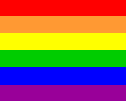
The rainbow flag: a colorful reminder of the diversity and scope of the gay and lesbian community. |
It makes sense to address ourselves the same way we want others to address us. Partners Task Force for Gay & Lesbian Couples will not embrace, or answer to, disrespectful terms like queer, faggot, poof, nelly, nance, pansy, maricones, locas, etc. This is the language of those who oppress us.
While some claim that using these words somehow dilutes them, or reclaims them, that approach does not seem to have an effect on those who persist in using these words in attacking us, nor in softening their impact when most of us hear them. Hateful words can be very potent and it makes no sense to encourage their use.
Dictionaries define the word queer as “unusual or abnormal” and also “worthless or counterfeit.” Gay men and lesbians are not queer. We have a different orientation, certainly not abnormal, worthless or fake. We are part of the fabric of every culture and society, and have been present during every age of history. We have added significantly to the world’s culture and sciences.
Further, the use of “queer” appears to be romanticized, and perpetuates the belief in being a “sexual outlaw.” Holding oneself apart from the mainstream creates a condition of separateness and devalues the transformative potential of inclusion. Accentuating our “difference” can lead to undervaluing the importance of demanding equality.
| Parallel Example |
While some black people call each other “nigger,” the black community has never used the term in identifying itself to the mainstream. It is rightly understood to be disrespectful. The term “queer” is just as offensive.
There is no “Nigger Nation,” as there was with the short lived militant political group “Queer Nation.” Nor is there a “Nigger Resources Directory,” as there is with the Internet database “Queer Resources Directory.”
| Who Asked You? |
In 2000, the National Gay and Lesbian Task Force (NGLTF) [After October 2014, known as the National LGBTQ Task Force.] funded a national survey of 2,645 individuals of color. Their survey report, “Say It Loud, I’m Black and I’m Proud: Black Pride Survey 2000,” highlights the fact that the term “queer” is one of the least used terms.
The survey discovered that less than 1 percent identified as “queer” when asked “Which comes closest to how you describe your sexual orientation?”
|
Sexual Orientation Labels NGLTF Black Pride Survey 2000 Results |
|
42 percent “gay” (nearly two thirds men, 12 percent women 24 percent “lesbian” 11 percent “bisexual” (13 percent men vs. 10 percent women) 8 percent “same gender loving” (10 percent men vs. 5 percent women) 4 percent “in the life” 3 percent “straight/heterosexual” 3 percent “other” (included: “open to love,” “closeted,” “faggot,” “questioning,” “curious,” “I like what I like”) 1 percent “transgender” 1 percent “two-spirit” 1 percent “one of the children” 1 percent “in the family” 1 percent “queer” |
According to the NGLTF survey report, “In contrast to the high levels of agreement on the labels “gay” and “lesbian,” Black GLBT people do not readily, or even remotely, identify as ‘queer.’ ”
| Supportive Perspectives |
“In its current rendition, queer politics is coded with class, gender, and race privilege, and may have lost its potential to be a politically expedient organizing tool for addressing the needs and mobilizing the bodies of people of color.”— Cathy Cohen in “Punks, Bulldaggers, and Welfare Queens:
The Radical Potential of Queer Politics?”
1997 Gay and Lesbian Quarterly. 3: 449
“When queer was used by angry gay men to focus attention on the fact that this society has no problem letting us die, I called myself ‘queer.’ I read ‘Queers Read This,’ and identified with those sentiments.“For the last few years, the term queer has been adopted by many, many people who are not homosexual in any way. Straight S/Mers use the term. Straight transvestites call themselves queer. Even supportive straights think they have the right to be called queer.
“It has become a catch phrase for anyone who wants to perceive themselves as being different from the mainstream. In this light, it no longer refers directly to an identifiable group who are denied civil rights in this country.
“Gay men and lesbians are denied civil rights, including the right to be married under the law. ‘Queers’ are only denied these rights when they enter a gay or lesbian relationship. Queer has become counter productive and misleading as a means for describing the legal status of gay men and lesbians in America.”
— Keith Keilman, e-mail to Partners, January 23, 1996
| Seeking Symbols |
When launching Partner Task Force in 1989, we searched for graphic symbols to represent couples, trying many combinations. We used inter linked male symbols and inter linked female symbols, as well as inter linked triangles. The triangles were a potent and widely used graphic at the time.
The pink triangle was first used by the Nazis to label those homosexual men they kidnapped for the work and extermination camps. It is a horrible and important reminder of the extent to which all right-wing political parties are capable.
It is not, however, a positive image of gay liberation. Because it is the visual language of an oppressor, we no longer think it wise to use the triangle to represent our community — any more than we would follow the other Nazi practice of tattooing prisoner numbers on our arms.
One of the best symbols, which represent the diversity and scope of the gay and lesbian community, is the rainbow flag. It was designed by Gilbert Baker in 1978 for his friend Harvey Milk. It was used in the San Francisco Gay and Lesbian Freedom Day Parade that year.
This flag has since been used at gay pride events worldwide, as well as presented as banners, clothing, bumper stickers, and jewelry. For the 25th Anniversary of the Stonewall riots held in 1994 in New York city, a mile-long rainbow flag was created, and cut up in sections after the parade to be used around the world.
| Enhancing Self-Esteem |
It is important to use both written and visual language in ways that enhance our self image and self-esteem. It makes sense to use the best of what describes us, not the labels used against us to belittle, imprison, or attack.
It is important to plan for the future. When all citizens have achieved the same opportunities and are not penalized for being lesbian or gay, will anyone still insist on being called a “queer?” We can hasten that future by embracing equality in the words we choose to identify ourselves.
“No government has the right to tell its citizens whom to love. The only queer people are those who don’t love anybody.”— Rita Mae Brown, at the opening ceremony, Gay Olympics, San Francisco, August 28, 1982